
Virabhadrasana III (Warrior III Pose)
Sanskrit Name: Vīrabhadrāsana III
English Name: Warrior III Pose
Category: Balance Asanas
Difficulty: Intermediate
Recommended Hold: 10–20 seconds on each side
What Is Virabhadrasana III?
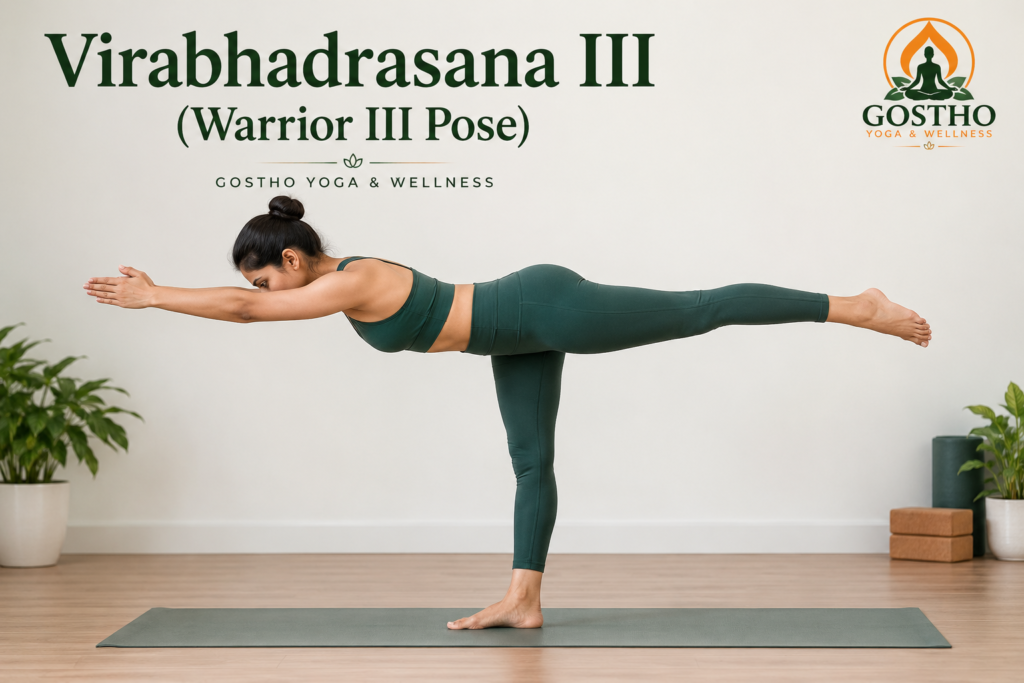
Virabhadrasana III, commonly known as Warrior III Pose, is a standing balance posture in which the body is supported on one leg while the other leg extends backward.
The torso and lifted leg gradually move toward a nearly horizontal position, creating a long line through the body. This pose encourages balance, concentration, body awareness and controlled movement.
How to Do Virabhadrasana III
- Begin standing upright in Tadasana.
- Step one foot slightly forward and place your weight evenly through that foot.
- Keep the standing knee soft rather than locking it.
- Place your hands on your hips or extend your arms forward when you feel stable.
- Slowly shift your body weight onto the standing leg.
- Hinge forward from the hips while lifting the opposite leg behind you.
- Keep the lifted leg active and extend through the heel.
- Try to keep both hips facing toward the floor rather than allowing the lifted-side hip to open.
- Lengthen the spine and keep the neck in a neutral position.
- Continue lowering the torso and lifting the back leg only as far as you can maintain control.
- Keep your gaze on a steady point on the floor.
- Breathe calmly and hold the position for 10–20 seconds.
- Slowly return to standing and repeat on the opposite side.
Breathing Guide
Inhale while preparing and lengthening the spine.
Exhale gradually as you hinge forward and lift the back leg.
While holding the posture, maintain slow and steady breathing. Avoid holding your breath or creating unnecessary tension in the shoulders, jaw or face.
Duration and Repetitions
Beginners can start with approximately 5–10 seconds on each side.
As balance and strength improve, gradually increase the hold to 10–20 seconds.
Practise 2–3 rounds on each side, resting briefly between rounds if needed.
Benefits of asana
Regular, comfortable practice may help:
Develop controlled movement and confidence in standing balance poses.
Improve balance and coordination
Strengthen the standing leg
Engage the hips and core muscles
Support body awareness and postural control
Encourage concentration and mental focus
Improve stability around the ankles and legs
Beginner / Training Tips
Keep your hands on your hips while learning the pose.
Practise near a wall, chair or other stable support until your balance improves.
You do not need to bring the torso completely parallel to the floor. A smaller forward hinge with good alignment is better than forcing a deeper position.
Keep the standing knee slightly soft if locking the knee feels uncomfortable.
Mindful Focus / Mental Awareness
Keep your attention calm and steady while balancing.
Feel the standing foot connecting firmly with the ground while the lifted leg extends backward.
As you breathe, imagine creating length and stability through the entire body.
Allow your mind to remain focused on balance, steady breathing and controlled movement rather than forcing the posture.
Who Should Avoid or Seek Guidance
People with a recent or significant ankle, knee, hip or lower-back injury should seek appropriate professional guidance before practising Virabhadrasana III.
Anyone experiencing severe dizziness, poor balance or pain while standing on one leg should practise with suitable support and supervision.
Precautions
Move slowly into and out of the posture.
Keep your standing foot firmly grounded and avoid twisting the standing knee.
Do not lift the back leg higher by excessively arching the lower back.
If you experience sharp pain, dizziness or unusual discomfort, release the posture and stop the practice.
Common Mistakes
Common mistakes include:
- Locking the standing knee
- Opening the lifted-side hip too far
- Lifting the back leg higher than the torso can control
- Rounding or excessively arching the spine
- Holding the breath
- Looking too far forward and straining the neck
- Trying to reach the full position before developing sufficient balance
Special Practice Note
The goal of Virabhadrasana III is not to lift the back leg as high as possible.
Focus on creating a stable standing leg, a long spine, steady hips and calm breathing.
A smaller, well-controlled posture is more useful than a deeper position performed without balance or alignment..
Watch this asana Practice
Related Asanas
Tadasana
Virabhadrasana I
Virabhadrasana II
Vrikshasana
Utkatasana