Back and neck stiffness can develop after long periods of sitting, working at a computer, using a phone, travelling, or simply moving less during the day. Gentle yoga may help you become more aware of posture, encourage comfortable movement, and support relaxation.
The goal of this practice is not to force flexibility. Move slowly, stay within a comfortable range, and focus on relaxed breathing.
Important: This article is for general educational purposes only and is not a substitute for medical advice, diagnosis, or treatment. If you have an injury, severe or persistent pain, numbness, weakness, dizziness, pain spreading into an arm or leg, or another medical condition, consult a qualified healthcare professional before starting a new exercise routine.
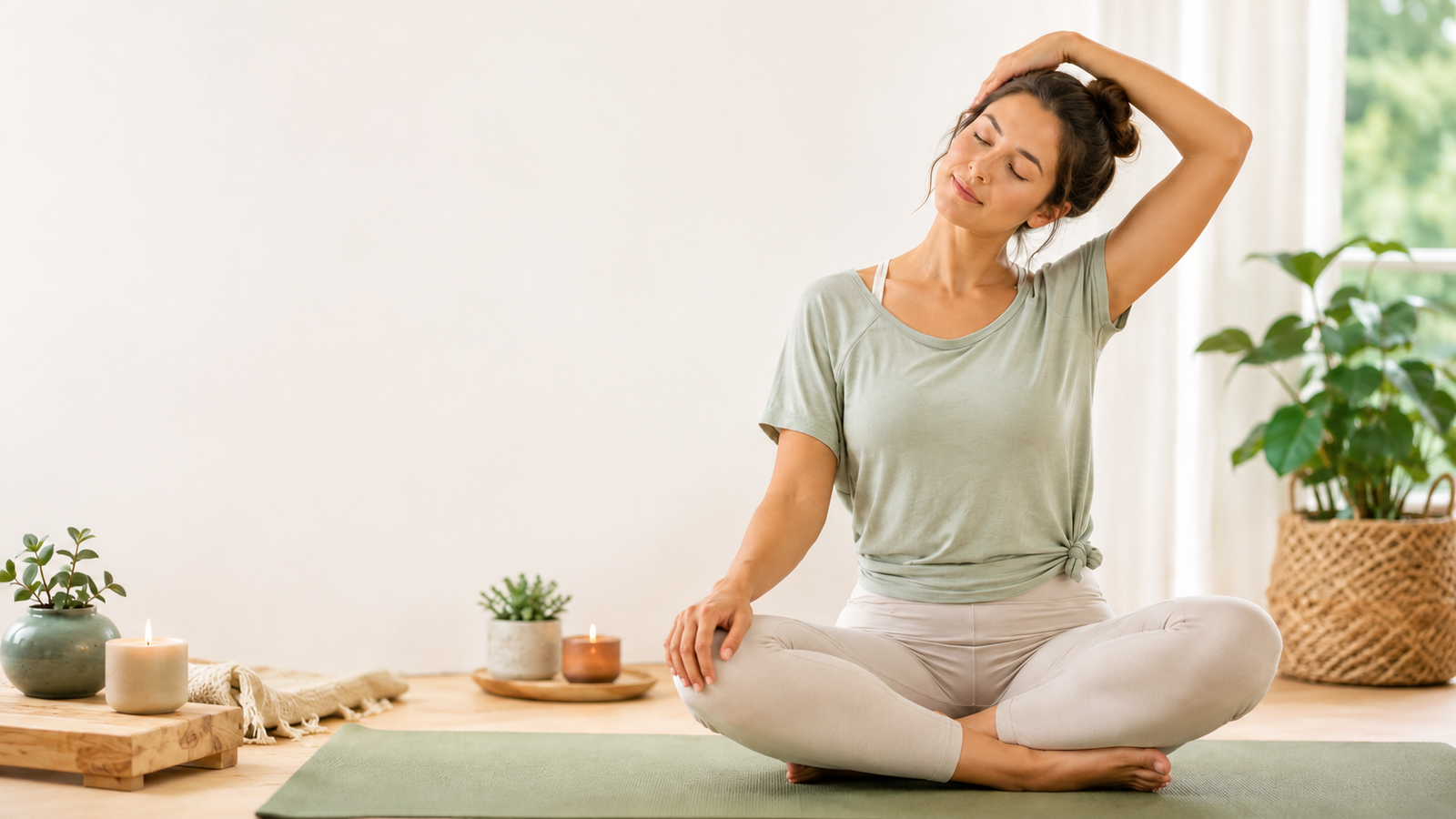
1. Gentle Neck Side Stretch
This simple movement can be performed while sitting comfortably on a chair or on the floor.
How to practice:
- Sit upright with your shoulders relaxed.
- Keep your face looking forward.
- Slowly bring your right ear toward your right shoulder.
- Do not lift the shoulder toward the ear.
- Stay for about 10–20 seconds while breathing normally.
- Return to the centre and repeat on the other side.
Avoid pulling your head strongly with your hand. The movement should feel gentle rather than forced.
2. Slow Neck Rotation
Gentle rotation can help you explore comfortable neck mobility.
How to practice:
- Sit or stand with a tall but relaxed posture.
- Slowly turn your head toward the right.
- Move only as far as feels comfortable.
- Return to the centre.
- Slowly turn toward the left.
- Repeat 3–5 times on each side.
Keep the movement smooth. Avoid making fast circles with the neck, especially if you experience dizziness or discomfort.
3. Shoulder Rolls
Shoulder rolls are a simple way to release unnecessary tension around the shoulders and upper back.
How to practice:
- Sit or stand comfortably.
- Lift both shoulders gently toward your ears.
- Roll them backward and down.
- Repeat 5–10 times.
- Then reverse the direction if comfortable.
Try to coordinate the movement with slow breathing.
4. Cat-Cow Movement
Cat-Cow introduces gentle movement through the spine and may be useful as part of a warm-up.
How to practice:
- Begin on your hands and knees.
- Place your wrists roughly under your shoulders and knees under your hips.
- As you inhale, gently allow your chest to move forward while keeping the neck comfortable.
- As you exhale, gently round your back and allow your head to follow naturally.
- Continue slowly for 5–8 rounds.
Do not force a deep arch in the lower back or throw the head backward.
If being on your hands and knees is uncomfortable, skip this practice.
5. Child’s Pose
Child’s Pose can be used as a resting position during a gentle yoga session.
How to practice:
- Begin on your hands and knees.
- Slowly move your hips toward your heels.
- Reach your arms forward or rest them beside your body.
- Let your head rest comfortably on the mat, a cushion, or another suitable support.
- Breathe naturally for 20–60 seconds.
Your knees can remain together or move slightly apart depending on comfort.
If this position causes knee, hip, or back discomfort, come out of the pose.
6. Seated Cat-Cow
If floor-based yoga is uncomfortable, Seated Cat-Cow is a useful alternative.
How to practice:
- Sit toward the front of a stable chair.
- Place both feet comfortably on the floor.
- Rest your hands on your thighs.
- As you inhale, gently lift your chest.
- As you exhale, gently round your upper back.
- Repeat 5–8 times.
Keep the movement small and controlled. There is no need to move into an extreme position.
7. Gentle Seated Twist
A comfortable seated twist may help you explore movement through the upper body.
How to practice:
- Sit upright on a stable chair.
- Keep both feet on the floor.
- Place your hands comfortably on your thighs.
- Slowly turn your chest slightly toward the right.
- Keep the movement gentle and avoid forcing your neck.
- Return to the centre.
- Repeat toward the left.
Hold each side for a few relaxed breaths if comfortable.
The movement should come gradually through the torso rather than by pulling strongly with the arms.
8. Relaxed Breathing in a Comfortable Position
Back and neck comfort is not only about stretching. Relaxed breathing can also be a useful part of a gentle yoga routine.
How to practice:
- Sit or lie in a comfortable position.
- Relax your shoulders and jaw.
- Breathe in gently through your nose.
- Allow the breath to leave slowly and comfortably.
- Continue for 1–3 minutes.
There is no need to take extremely deep breaths or hold your breath.
If breathing exercises make you feel dizzy or uncomfortable, return to your normal breathing pattern.
A Simple 10-Minute Routine
Beginners can combine the practices into a short routine:
- Shoulder Rolls — 1 minute
- Gentle Neck Side Stretch — 1 minute
- Slow Neck Rotation — 1 minute
- Cat-Cow or Seated Cat-Cow — 2 minutes
- Gentle Seated Twist — 2 minutes
- Child’s Pose or comfortable resting position — 1 minute
- Relaxed Breathing — 2 minutes
You do not need to complete every movement. Choose the practices that feel appropriate for you.
Tips for Practising Comfortably
Keep these basic principles in mind:
- Move slowly instead of using momentum.
- Avoid forcing a stretch.
- Keep breathing naturally.
- Stop a movement if it increases pain.
- Use a chair, cushion, folded blanket, or other support when useful.
- Short and comfortable practice sessions are often easier to maintain than long, intense sessions.
- Take regular movement breaks if you spend many hours sitting.
Frequently Asked Questions
How often can beginners practise gentle yoga?
A short, comfortable practice can be included regularly depending on your health, activity level, and individual needs. Beginners may prefer starting with short sessions and gradually adjusting their routine.
Should yoga hurt when stretching?
No. A mild stretching sensation may occur, but sharp, intense, electrical, or worsening pain is a reason to stop the movement.
Can I practise these movements while sitting in a chair?
Yes. Several movements, including shoulder rolls, gentle neck movements, seated Cat-Cow, breathing, and gentle twists, can be adapted to a stable chair.
Can yoga cure back or neck pain?
Yoga should not be considered a guaranteed cure for back or neck pain. Pain can have many different causes. Yoga may be one part of a broader wellness or movement routine when appropriate, but persistent or concerning symptoms should be evaluated by a qualified healthcare professional.
Final Thoughts
Gentle yoga does not need to be complicated. A few minutes of comfortable movement, posture awareness, and relaxed breathing can be a practical way to include more movement in your day.
Start slowly, respect your body’s limits, and focus on consistency rather than intensity.
Pingback: 7 Gentle Yoga Movements to Support Joint Mobility and Flexibility – GOSTHO Yoga & Wellness
Pingback: Daily Posture and Mobility Tips for People Who Sit for Long Hours – GOSTHO Yoga & Wellness