
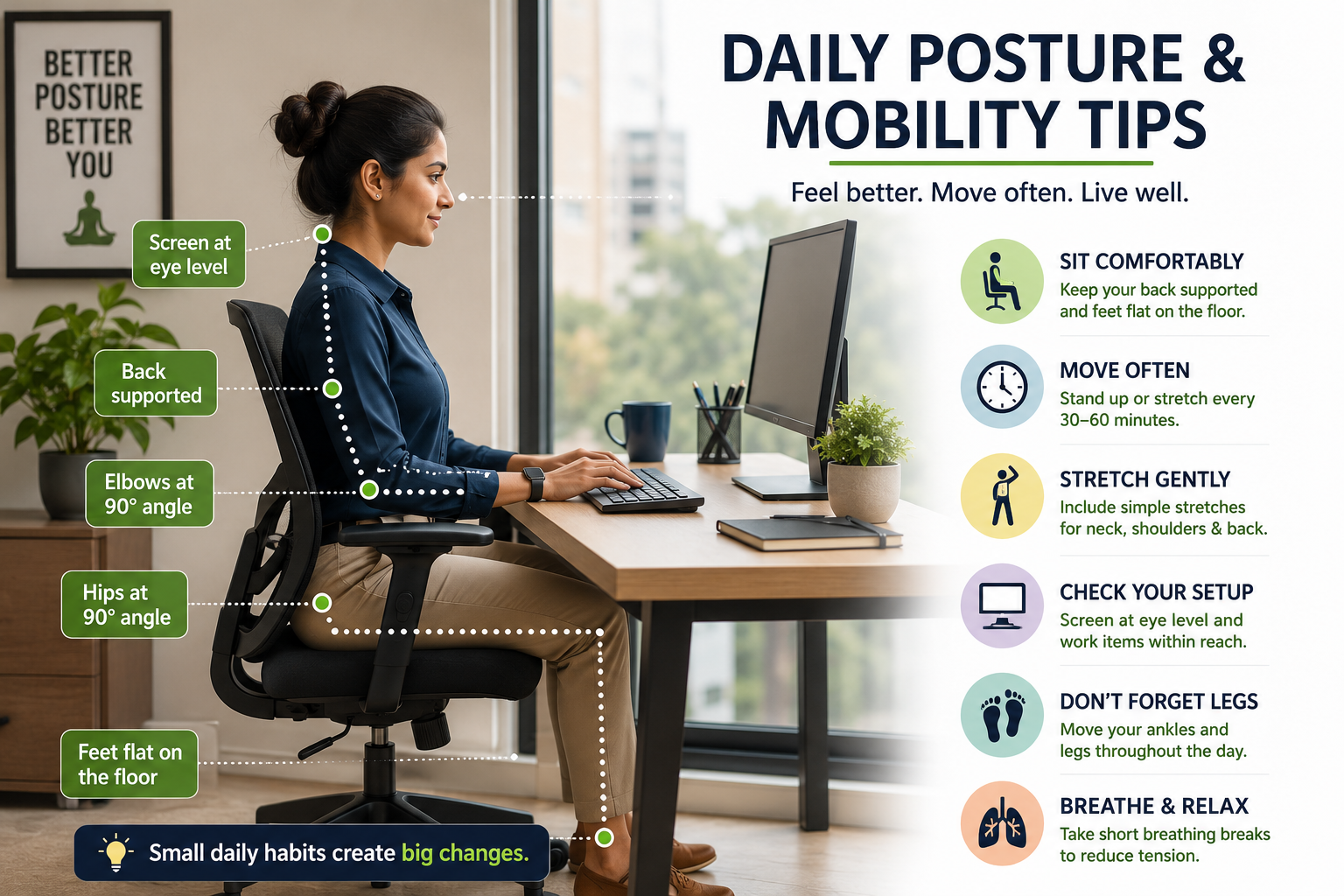
Sitting for long periods can leave the neck, shoulders, back, hips, and legs feeling stiff or tired. People who work at a desk, drive for long hours, study, or spend a lot of time using a computer or phone may benefit from regular movement breaks and simple posture habits.
The goal is not to sit in one “perfect” posture all day. A more practical approach is to change positions regularly, move often, and keep your workstation as comfortable as possible.
Important: This article is for general educational and wellness purposes only and is not a substitute for medical advice, diagnosis, or treatment. If you have severe or persistent pain, numbness, weakness, pain spreading into an arm or leg, a recent injury, or another medical condition, consult a qualified healthcare professional.
1. Change Your Sitting Position Regularly
There is no single sitting posture that needs to be maintained perfectly for hours.
Instead:
- sit comfortably with your feet supported
- avoid staying in exactly the same position for too long
- shift your weight occasionally
- stand up when possible
- change between sitting and standing if your workspace allows it
Movement and variety are often more practical than trying to hold one rigid posture.
2. Keep Your Feet Supported
When sitting, try to keep your feet comfortably supported on the floor or on a footrest.
A useful starting position is:
- feet flat
- knees comfortable
- hips supported by the chair
- shoulders relaxed
Avoid forcing your knees or hips into an exact angle if it feels uncomfortable.
3. Adjust Your Screen Height
Looking down at a laptop or phone for long periods can make the neck feel uncomfortable.
For a desktop setup:
- keep the screen roughly in front of you
- avoid turning your head constantly to one side
- raise the monitor if it is very low
- position frequently used items within easy reach
For laptops, an external keyboard and mouse can make it easier to raise the screen while keeping the hands comfortable.
4. Relax Your Shoulders
Many people unconsciously lift their shoulders while typing or concentrating.
Try this quick reset:
- Sit comfortably.
- Notice whether your shoulders are tense.
- Lift them gently toward your ears.
- Slowly roll them backward and down.
- Repeat 5 times.
- Let your arms relax.
You can repeat this several times during the day.
5. Take Short Movement Breaks
A short movement break does not need to become a full workout.
Every 30–60 minutes, when practical, try:
- standing up
- walking for a minute
- shoulder rolls
- ankle movements
- gentle stretches
- getting a glass of water
Even small breaks can help interrupt long periods of uninterrupted sitting.
6. Try Seated Cat-Cow
Seated Cat-Cow is a simple chair-based movement for the spine.
How to practise:
- Sit toward the front of a stable chair.
- Place both feet on the floor.
- Rest your hands on your thighs.
- Inhale and gently lift your chest.
- Exhale and gently round your upper back.
- Repeat 5–8 times.
Keep the movement small and comfortable.
7. Add Gentle Neck Movement
After long periods of looking at a screen, gentle neck movement may feel useful.
Try:
- Sit upright with your shoulders relaxed.
- Slowly turn your head toward the right.
- Return to the centre.
- Turn toward the left.
- Repeat 3–5 times on each side.
You can also perform a gentle side stretch by moving one ear toward the same-side shoulder.
Avoid fast neck circles or forcing the range.
8. Move Your Wrists and Hands
Typing, using a mouse, and holding a phone can involve repeated hand and wrist activity.
Try this simple break:
- Relax your arms.
- Open and close your hands 5–10 times.
- Circle your wrists slowly.
- Reverse direction.
- Gently shake your hands out.
Stop if a movement causes pain, tingling, or numbness.
9. Move Your Ankles and Legs
The lower body also benefits from regular movement.
While sitting:
- lift one heel, then the other
- perform ankle circles
- straighten one knee gently
- alternate legs
- stand and walk when possible
These movements can be included during short work breaks.
10. Use a Gentle Seated Twist
A comfortable seated twist can add variety to your posture.
How to practise:
- Sit upright on a stable chair.
- Keep both feet supported.
- Turn your chest slightly toward the right.
- Avoid pulling strongly with your arms.
- Take 1–2 relaxed breaths.
- Return to the centre.
- Repeat on the left.
Keep the movement gentle.
A Simple 5-Minute Desk Mobility Break
Try this short routine:
- Shoulder Rolls — 30 seconds
- Neck Turns — 30 seconds
- Seated Cat-Cow — 1 minute
- Wrist Circles — 30 seconds
- Ankle Circles — 1 minute
- Seated Twist — 1 minute
- Stand and Walk — 30 seconds
You can adjust the routine depending on your workspace and comfort.
Simple Workstation Tips
A comfortable workstation may include:
- a chair that supports you comfortably
- feet supported
- keyboard and mouse within easy reach
- screen positioned in front of you
- frequently used objects close by
- enough space to change position
There is no need to create an expensive setup. Small adjustments can sometimes make the workspace easier to use.
Phone Posture Matters Too
Long periods of looking down at a phone can also contribute to discomfort.
Try to:
- bring the phone closer to eye level when practical
- take frequent breaks
- avoid holding the same position for long periods
- alternate hands
- relax your shoulders
- avoid prolonged phone use when lying in an awkward position
Again, the goal is movement and variety rather than maintaining one perfect posture.
Do Not Ignore Persistent Symptoms
Occasional stiffness after sitting may improve with movement, but some symptoms deserve professional assessment.
Seek medical advice if you have:
- persistent or worsening pain
- numbness or tingling
- weakness
- loss of coordination
- pain after a significant injury
- severe headaches associated with neck symptoms
- symptoms that interfere with sleep or daily activities
Yoga and posture exercises should not replace appropriate medical evaluation.
Frequently Asked Questions
How often should I stand up from my desk?
There is no single rule for everyone. A practical approach is to change position or take a brief movement break every 30–60 minutes when possible.
Is standing all day better than sitting?
Not necessarily. Staying in any one position for too long may become uncomfortable. Alternating between sitting, standing, and moving is often more practical.
Can posture exercises fix back pain?
Posture and mobility exercises may support comfort, but back pain can have many causes. Persistent or severe pain should be professionally assessed.
Should my back stay perfectly straight while sitting?
No. Sitting rigidly for long periods can also become uncomfortable. Aim for a supported, relaxed posture and change positions regularly.
Can I do these movements at work?
Yes. Many of them are chair-based and can be performed during short breaks, as long as your environment is safe.
What if I cannot take long breaks?
Even 1–2 minutes of movement can be useful. Stand up, walk briefly, move your shoulders, or change your position.
Use the GOSTHO Yoga Tools
You can also use the tools available on our Yoga Tools page to support your routine:
- Yoga Session Timer
- Pose Hold Timer
- Daily Yoga Planner
- Breathing Timer
A short reminder or timer can help you build regular movement breaks into the day.
Final Thoughts
People who sit for long hours do not need to achieve perfect posture.
A better approach is to create a comfortable workspace, change positions regularly, take short movement breaks, and include gentle mobility exercises throughout the day.
Small adjustments repeated consistently can make a daily routine feel more comfortable and manageable.
Pingback: Gentle Yoga for Back and Neck Comfort: 8 Beginner-Friendly Practices – GOSTHO Yoga & Wellness
Pingback: 7 Gentle Yoga Movements to Support Joint Mobility and Flexibility – GOSTHO Yoga & Wellness
Pingback: 10 Simple Healthy Habits to Build a Better Daily Routine – GOSTHO Yoga & Wellness
Pingback: 10 Simple Healthy Habits for a Better Daily Routine