Breathing exercises can be a simple part of yoga, meditation, and everyday wellness. For beginners, the most important thing is not how long you can hold your breath or how deeply you can inhale. The goal is to breathe comfortably, stay relaxed, and gradually become more aware of your natural breathing pattern.
You can begin with only a few minutes at a time. There is no need to force the breath or follow complicated techniques.
Important: This article is for general educational and wellness purposes only and is not a substitute for medical advice, diagnosis, or treatment. If you have breathing difficulty, chest pain, fainting, significant dizziness, a heart or respiratory condition, or another medical concern, consult a qualified healthcare professional before beginning breathing exercises. Severe or sudden breathing difficulty requires urgent medical attention.
1. Start with Your Natural Breath
Before trying timed breathing, spend a minute simply noticing how you already breathe.
How to practice
- Sit comfortably on a chair, cushion, or mat.
- Relax your shoulders and jaw.
- Keep your spine comfortable rather than rigid.
- Notice your inhale.
- Notice your exhale.
- Do not try to make either one longer.
- Continue for 1–2 minutes.
This is a useful starting point because it helps you become aware of the breath without adding pressure or complicated instructions.
2. Avoid Forcing Deep Breaths
Many beginners assume that a breathing exercise must involve very large breaths.
That is not necessary.
Taking breaths that are too deep or too fast can make some people feel light-headed or uncomfortable.
Instead:
- breathe gently
- keep your shoulders relaxed
- avoid lifting the chest aggressively
- stop if you feel dizzy
- return to normal breathing whenever needed
Comfort is more important than breath size.
3. Practise Gentle Belly Breathing
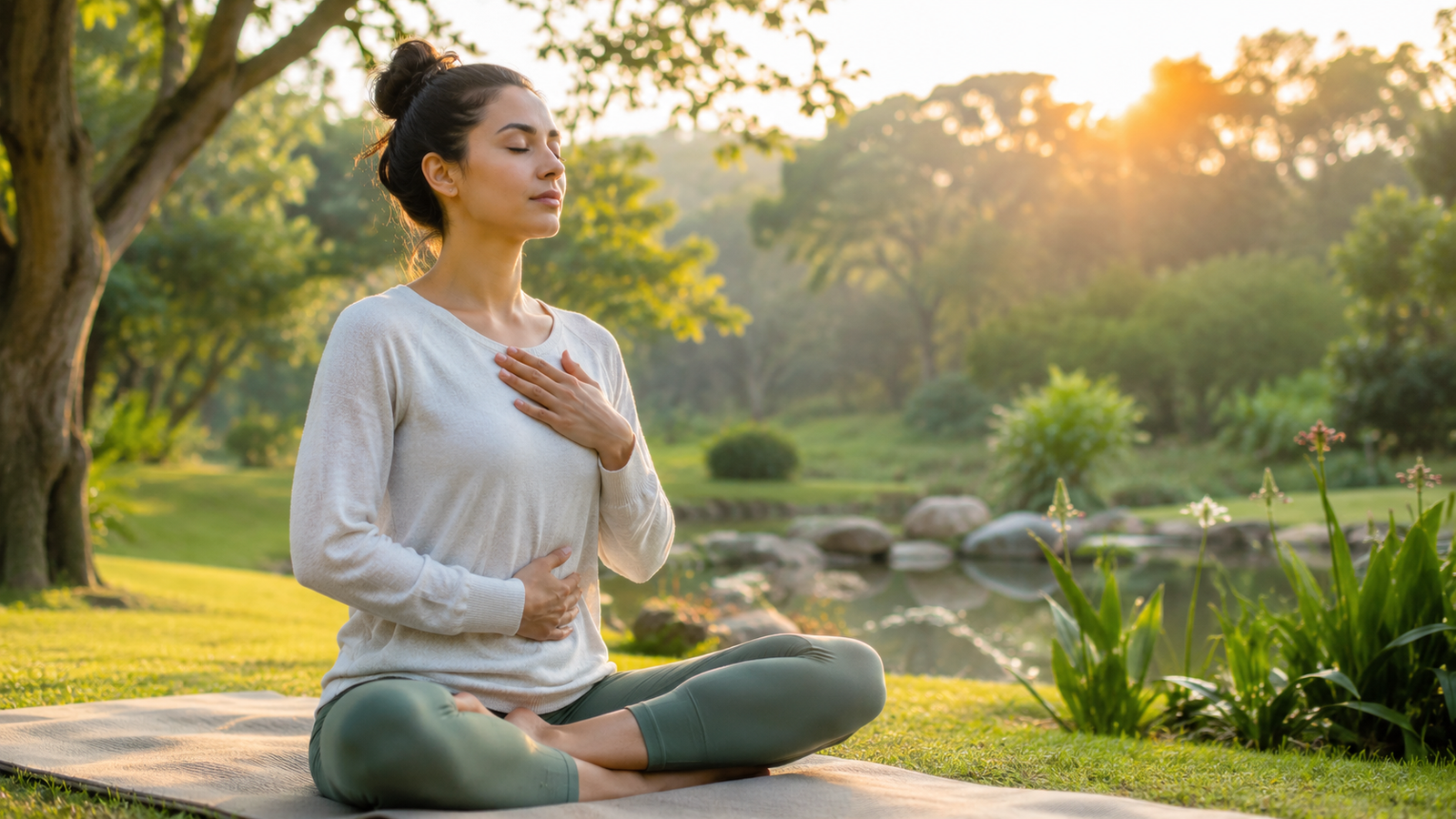
Belly breathing can help you notice movement around the abdomen during relaxed breathing.
How to practice
- Sit or lie comfortably.
- Place one hand gently over your abdomen.
- Relax your shoulders.
- Inhale naturally through your nose.
- Notice the abdomen moving slightly outward.
- Exhale gently.
- Notice the abdomen moving back.
- Repeat for 5–10 breaths.
Do not push your abdomen outward. Allow the movement to happen naturally.
4. Try Equal Breathing
Once natural breathing feels comfortable, you can experiment with equal timing.
A simple example is:
Inhale for 4 seconds
Exhale for 4 seconds
How to practice
- Sit comfortably.
- Inhale gently while counting to 4.
- Exhale gently while counting to 4.
- Repeat for about 5 rounds.
- Return to normal breathing.
If 4 seconds feels too long, use:
3 seconds in → 3 seconds out
There is no benefit in forcing yourself to follow a number that feels uncomfortable.
5. Try a Slightly Longer Exhale
Some people find it relaxing to let the exhale last slightly longer than the inhale.
A beginner-friendly example is:
Inhale: 4 seconds
Exhale: 6 seconds
You can also try:
Inhale: 3 seconds
Exhale: 4 seconds
How to practice
- Sit in a comfortable position.
- Relax your shoulders.
- Inhale gently.
- Allow the exhale to leave slowly.
- Repeat for about 5 rounds.
- Return to natural breathing.
The exhale should never feel strained.
6. Breath Holding Is Not Necessary
Beginners sometimes think yoga breathing must involve holding the breath.
It does not.
You can practise useful breathing awareness with:
Inhale → Exhale
without any pause or retention.
Breath holding may not be appropriate for everyone, particularly people with certain cardiovascular, respiratory, pregnancy-related, or other medical considerations.
For a beginner wellness practice, keeping Hold = 0 seconds is completely acceptable.
7. Keep Your Shoulders and Face Relaxed
Breathing exercises can become uncomfortable if you are unknowingly creating tension.
Occasionally check:
- Are your shoulders lifted?
- Is your jaw tight?
- Are you squeezing your eyes?
- Are your hands tense?
- Are you trying too hard?
Allow these areas to soften.
Breathing practice should generally feel calm rather than like a physical challenge.
8. Practise in a Comfortable Position
There is no single correct position for breathing exercises.
You can practise:
- sitting on a chair
- sitting on a cushion
- sitting cross-legged
- lying comfortably
- standing in a relaxed position
For beginners, a stable chair can be especially useful because it removes the need to maintain a difficult yoga posture.
9. Keep Beginner Sessions Short
Long sessions are not necessary.
A beginner can start with:
2–5 minutes
and gradually adjust based on comfort.
A simple session might be:
- Natural Breath Awareness — 1 minute
- Belly Breathing — 1 minute
- Equal Breathing — 1 minute
- Longer Exhale — 1 minute
- Natural Breathing — 1 minute
That is already a complete five-minute practice.
10. Stop if You Feel Uncomfortable
Breathing exercises should not make you feel trapped, dizzy, or unable to get enough air.
Stop structured breathing if you experience:
- dizziness
- unusual shortness of breath
- chest discomfort
- increasing anxiety
- faintness
- tingling that feels concerning
- unusual or worsening symptoms
Return to your normal breathing pattern and rest.
Persistent or significant symptoms should be assessed by an appropriate healthcare professional.
A Simple Beginner Breathing Routine
Try this gentle routine:
Minute 1 — Natural Breath Awareness
Simply observe your breathing.
Minute 2 — Belly Breathing
Notice gentle abdominal movement.
Minute 3 — Equal Breathing
Try 3–4 seconds in and 3–4 seconds out.
Minute 4 — Slightly Longer Exhale
Try 3 seconds in and 4 seconds out.
Minute 5 — Natural Breathing
Stop counting and allow your breathing to return to normal.
You can shorten or modify any part of the routine.
When Can You Practise Breathing Exercises?
A short breathing routine can fit into many parts of the day.
You might practise:
- after waking up
- before meditation
- during a work break
- after gentle yoga
- before your evening relaxation routine
- while sitting quietly outdoors
Avoid structured breathing exercises while driving, swimming, operating machinery, or doing anything that requires full attention.
Common Beginner Mistakes
Trying to breathe too deeply
Bigger is not always better. Gentle breathing is enough.
Holding the breath for too long
Beginners do not need breath retention.
Practising too quickly
Slow down and keep the breath comfortable.
Trying to match someone else
Your comfortable rhythm may be different from another person’s.
Continuing despite dizziness
Stop and return to natural breathing.
Making the practice complicated
Simple breathing awareness is already a valid practice.
Use the GOSTHO Breathing Timer
You can use the Breathing Timer on the Yoga Tools page for a simple timed practice.
A beginner-friendly starting pattern is:
Inhale: 4 seconds
Hold: 0 seconds
Exhale: 6 seconds
Cycles: 5
If that timing feels difficult, shorten it.
For example:
Inhale: 3 seconds
Hold: 0 seconds
Exhale: 4 seconds
The best setting is one that allows you to breathe comfortably without strain.
Frequently Asked Questions
How many minutes should a beginner practise?
Starting with 2–5 minutes is reasonable for a simple wellness practice. You can adjust based on comfort.
Should I breathe only through my nose?
Many gentle yoga breathing exercises use nasal breathing, but individual needs can vary. If nasal breathing is uncomfortable or difficult, do not force it.
Is it necessary to hold the breath?
No. Beginners can practise without any breath holding.
Why do I feel dizzy during deep breathing?
Breathing too quickly or excessively deeply can sometimes contribute to light-headedness. Stop the exercise, return to natural breathing, and rest. Seek medical advice if dizziness is severe, persistent, or recurrent.
Can breathing exercises cure anxiety or respiratory disease?
No. Breathing exercises should not be presented as a cure for anxiety disorders, asthma, COPD, or other medical conditions. They may be included as a general wellness practice when appropriate, but medical conditions require suitable professional care.
Can I practise before sleep?
A short, comfortable breathing routine may fit well into an evening relaxation routine for some people. Keep it gentle and avoid techniques that feel stimulating or uncomfortable.
Final Thoughts
Beginner breathing practice should be simple.
Start by noticing your natural breath, keep your shoulders relaxed, avoid forcing deep breaths, and use comfortable timing.
There is no need to hold your breath or practise for long periods.
A few calm minutes of breathing awareness can be enough to become part of a regular yoga and wellness routine.
Pingback: 7 Practical Sleep Tips for a Calmer Night Routine – GOSTHO Yoga & Wellness