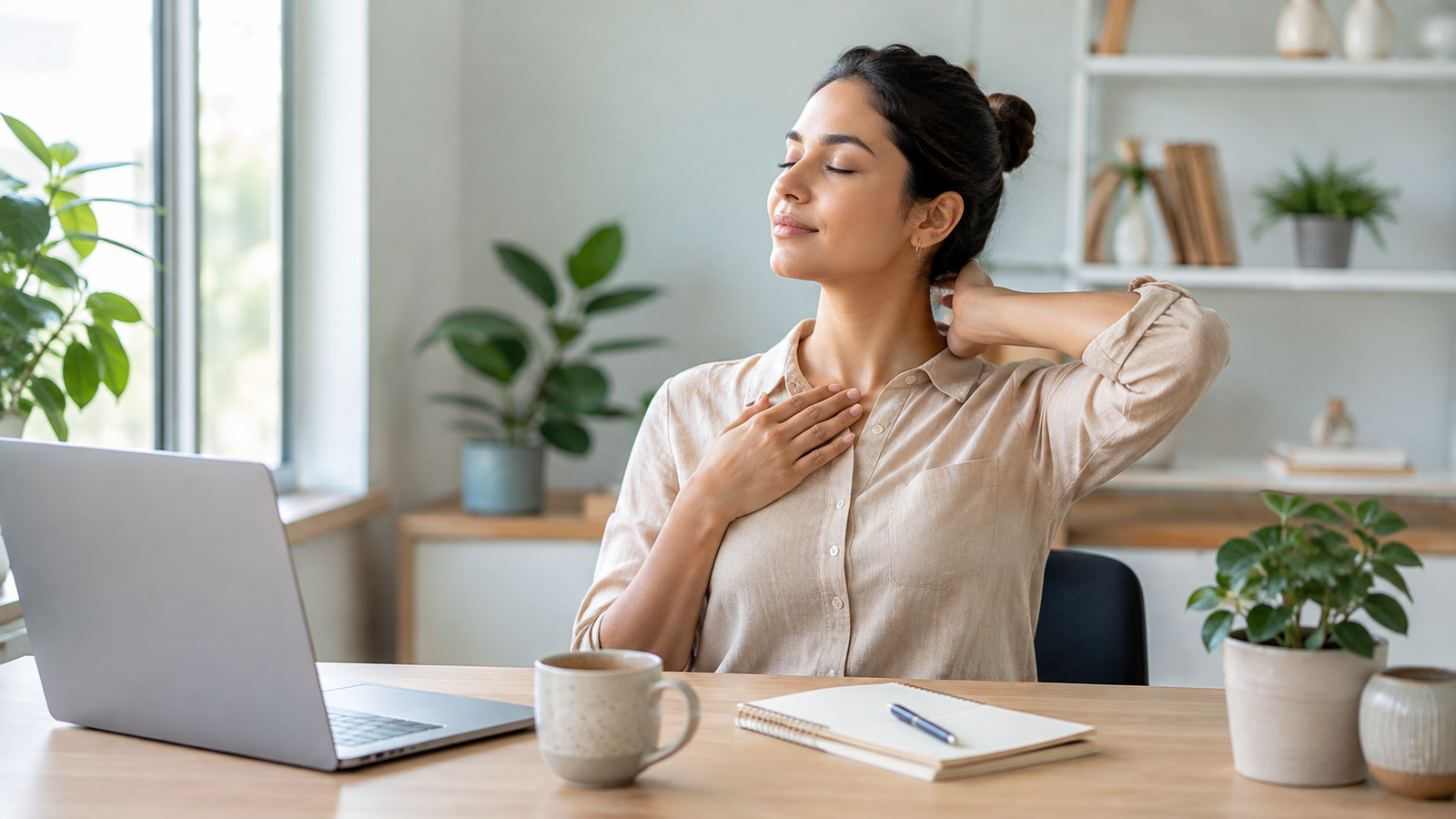
Everyday stress can come from work, family responsibilities, travel, financial worries, screen time, lack of rest, or simply having too many things to manage at once.
Gentle yoga, slow movement, breathing awareness, and short relaxation practices can be useful ways to create a calmer pause during the day. The goal is not to remove every source of stress, but to give your body and mind a few minutes to slow down.
Important: This article is for general educational and wellness purposes only and is not a substitute for medical advice, diagnosis, treatment, or mental health care. If stress, anxiety, low mood, sleep problems, panic symptoms, or other concerns are severe, persistent, or interfere with daily life, seek support from an appropriately qualified healthcare or mental health professional.
1. Begin with Shoulder Rolls
Stress can sometimes be accompanied by unnecessary tension around the shoulders and upper back.
How to practise:
- Sit or stand comfortably.
- Relax your arms beside your body.
- Slowly lift your shoulders toward your ears.
- Roll them backward and gently down.
- Repeat 5–10 times.
- Reverse the direction if comfortable.
Keep the movement slow rather than forceful.
2. Gentle Neck Side Stretch
Long periods of computer or phone use can leave the neck feeling stiff.
How to practise:
- Sit upright with your shoulders relaxed.
- Look forward.
- Slowly move your right ear toward your right shoulder.
- Stay for 10–20 seconds.
- Return to the centre.
- Repeat on the other side.
Avoid pulling strongly on your head.
If the movement causes pain, dizziness, numbness, or unusual symptoms, stop.
3. Seated Side Stretch
A gentle side stretch can add movement to a short work break or evening routine.
How to practise:
- Sit comfortably on a stable chair.
- Keep both feet supported.
- Raise one arm overhead.
- Lean gently toward the opposite side.
- Take 2–3 comfortable breaths.
- Return to the centre.
- Repeat on the other side.
Move only as far as feels comfortable.
4. Seated Cat-Cow
You do not need to get onto the floor to include gentle spinal movement.
How to practise:
- Sit toward the front of a stable chair.
- Rest your hands on your thighs.
- As you inhale, gently lift your chest.
- As you exhale, gently round your upper back.
- Repeat 5–8 times.
Keep the movement small and controlled.
5. Natural Breath Awareness
One of the simplest breathing practices is to observe your breath without trying to change it.
How to practise:
- Sit comfortably.
- Relax your shoulders and jaw.
- Notice the natural inhale.
- Notice the natural exhale.
- Avoid forcing deeper breathing.
- Continue for 1–3 minutes.
If your attention wanders, gently return it to the feeling of breathing.
6. Gentle Longer-Exhale Breathing
Some people find a slightly longer exhale comfortable during relaxation.
Try:
Inhale gently for 4 seconds
Exhale comfortably for 6 seconds
If that feels too long, use a shorter pattern such as:
3 seconds in → 4 seconds out
How to practise:
- Sit in a comfortable position.
- Relax your shoulders.
- Inhale gently.
- Exhale slowly without forcing the breath.
- Repeat for about 5 rounds.
- Return to natural breathing.
Breath holding is not necessary.
Stop if you feel dizzy, anxious, short of breath, or uncomfortable.
7. Child’s Pose or a Supported Resting Position
A short resting posture can be included after gentle movement.
If Child’s Pose is comfortable:
- Begin on your hands and knees.
- Move your hips gradually toward your heels.
- Support your forehead with a cushion if needed.
- Rest your arms comfortably.
- Stay for several relaxed breaths.
If this position is uncomfortable, choose a supported seated or lying position instead.
8. Short Mindfulness Pause
Stress management does not always require a formal meditation session.
Try a simple two-minute pause:
- Sit somewhere safe and comfortable.
- Put your phone aside.
- Relax your hands.
- Notice your breathing.
- Notice areas of tension without trying to force them away.
- Allow yourself to remain still for 1–2 minutes.
The goal is simply to pause.
A Simple 10-Minute Stress-Management Routine
You can combine these practices into a short routine:
- Shoulder Rolls — 1 minute
- Neck Stretch — 1 minute
- Seated Side Stretch — 1 minute
- Seated Cat-Cow — 2 minutes
- Natural Breath Awareness — 1 minute
- Gentle Longer Exhale — 2 minutes
- Comfortable Resting Position — 1 minute
- Quiet Mindfulness — 1 minute
You do not need to complete every practice.
Even a few minutes may be easier to fit into a busy day.
Simple Habits That May Support Stress Management
Yoga and breathing can be part of a broader wellness routine.
Other helpful habits may include:
- taking regular movement breaks
- maintaining a consistent sleep routine
- spending some time outdoors
- reducing unnecessary screen time
- talking with supportive friends or family
- making time for enjoyable activities
- eating regular balanced meals
- setting realistic daily priorities
- taking short breaks from work
- seeking professional support when needed
Stress management is not about being calm all the time. It is about having practical ways to respond when life feels demanding.
Avoid Forcing Relaxation
Sometimes trying very hard to “relax” can make a person feel more frustrated.
Instead of expecting an immediate change, simply focus on:
- comfortable movement
- natural breathing
- short pauses
- reducing unnecessary tension
- creating a consistent routine
Different practices work for different people.
When Stress May Need Professional Support
Everyday stress is common, but professional support may be appropriate when symptoms become persistent or difficult to manage.
Consider seeking qualified help if you experience:
- ongoing anxiety
- frequent panic symptoms
- persistent low mood
- severe sleep disruption
- difficulty functioning at work or home
- loss of interest in normal activities
- significant changes in appetite or energy
- feeling overwhelmed most of the time
Yoga and breathing practices can complement appropriate care, but they should not replace professional mental health treatment when it is needed.
Frequently Asked Questions
How long should I practise yoga for stress management?
A short 5–15 minute routine can be enough to create a regular wellness habit. Longer sessions are not automatically better.
Which breathing technique is best for beginners?
Natural breath awareness is usually a simple place to start. A comfortable longer exhale can be added later if it feels easy.
Do I need to hold my breath?
No. Breath holding is not necessary for a beginner stress-management practice.
Can yoga cure anxiety?
No. Yoga should not be presented as a cure for anxiety disorders. It may support relaxation and general well-being, but persistent anxiety should be appropriately assessed and treated.
Can I practise during a work break?
Yes. Chair-based movements, shoulder rolls, gentle stretches, and one or two minutes of breathing awareness can fit into a short break.
What if breathing exercises make me more anxious?
Stop the structured breathing exercise and return to normal breathing. Some people are more comfortable with gentle movement, walking, or another relaxation method instead.
Use the GOSTHO Yoga Tools
For a simple guided practice, you can use the tools available on our Yoga Tools page:
- Breathing Timer
- Meditation Timer
- Yoga Session Timer
- Daily Yoga Planner
For breathing, start with a comfortable pattern such as:
Inhale: 4 seconds
Hold: 0 seconds
Exhale: 6 seconds
Adjust the timing if needed. Comfort is more important than following a particular number.
Final Thoughts
Managing everyday stress does not require a complicated yoga routine.
Gentle movement, comfortable breathing, a short mindfulness pause, and regular breaks can all become practical parts of daily life.
Start with a few minutes, choose practices that feel comfortable, and remember that asking for professional support is appropriate when stress becomes difficult to manage.
Pingback: 5 Simple Breathing Practices for Calm and Breath Awareness – GOSTHO Yoga & Wellness
Pingback: Gentle Yoga and Wellness Practices for Women’s Daily Routine – GOSTHO Yoga & Wellness